
How to get a mortgage when you're self-employed
Self-employed? Getting a mortgage mostly comes down to the right paperwork. Here's what lenders want to see and how to put your best case forward.
If you work for yourself, you have probably heard that getting a mortgage is a nightmare. It isn't, but the paperwork is different, and this guide explains how to get a mortgage when self-employed: what lenders count, what they want to see and how to prepare.
Key takeaways
- Lenders generally treat you as self-employed if you own 20% or more of the business you earn from.
- Sole traders, partners and limited company directors are each assessed slightly differently.
- Tidy bookkeeping and up-to-date tax returns make an application far more straightforward.
- Lenders treat self-employed income very differently, so the lender you choose can change how much you can borrow.
Why self-employed mortgages feel harder
Lenders need a clear way to understand your income when there is no monthly payslip. An employed applicant can show a contract and recent payslips, and the lender can see a steady figure straight away.
When you work for yourself, your income can rise and fall from year to year, and it may come from several sources. Lenders aren't against self-employed borrowers. They simply need more evidence to be comfortable that the income is reliable.
What counts as self-employed
Lenders generally treat you as self-employed if you own 20% or more of the business you earn from. That covers sole traders, partners and limited company directors, and each is assessed slightly differently.
If you own less than that, some lenders may look at you as an employee of the business instead and focus on your salary. Contractors and freelancers can also fall into different categories depending on how they are paid, so it is worth checking how a lender will see you before you apply.
How to get a mortgage when self-employed: what lenders want to see
The evidence a lender asks for depends on how your business is set up.
- Sole traders, usually two years of tax calculations (SA302s) and the matching tax year overviews from HMRC.
- Limited company directors, typically salary plus dividends, or in some cases your share of net profit. Two years of accounts is common.
- Everyone, recent business and personal bank statements, and proof the business is trading steadily.
On top of that, expect the usual documents every applicant needs: ID, proof of address and proof of deposit. If you run a limited company, our guide to how lenders assess income for limited company directors goes into the different methods in more detail.
The single biggest thing you can do is keep your bookkeeping tidy and your tax returns up to date. Clean, consistent figures make your application straightforward.
Why the right lender matters so much
Lenders treat self-employed income very differently from one another. One might average your last two years, another might use the most recent (and higher) year, and another might focus on retained profit. For the same person, that can change how much you can borrow.
This is where a broker earns their keep. Rather than applying to one bank and hoping, we match your specific income structure to lenders whose criteria fit it, and who may lend a sensible amount.
Applying to the wrong lender first can also cost time. A decline doesn't stop you applying elsewhere, but it is far better to understand a lender's approach before your details go in.
Common mistakes to avoid
A few avoidable issues come up again and again with self-employed applications.
- Late or missing tax returns. If your latest year isn't filed, a lender may not be able to use it.
- Mixing business and personal spending. Separate accounts make your figures much easier for an underwriter to follow.
- Unexplained dips in income. If a year was lower for a clear reason, such as a one-off cost or time off, be ready to explain it.
- Taking on new credit just before applying. New borrowing adds to your monthly commitments and can reduce what a lender will offer.
Give yourself the best run-up
If you know you want to buy in the next year or two, a little planning can help.
- Avoid reducing your declared income purely to lower a tax bill, because lenders lend against what you declare.
- Get your paperwork in order. Keep your SA302s, tax year overviews or company accounts, and recent bank statements, easy to find.
- Check your credit file and correct any errors.
- Speak to an adviser early. A quick conversation now can shape how you prepare, so that when you're ready to apply, the numbers are presented as clearly as possible.
An agreement in principle can then give you an early indication of what a lender may offer before you start viewing properties.
Think about protection too
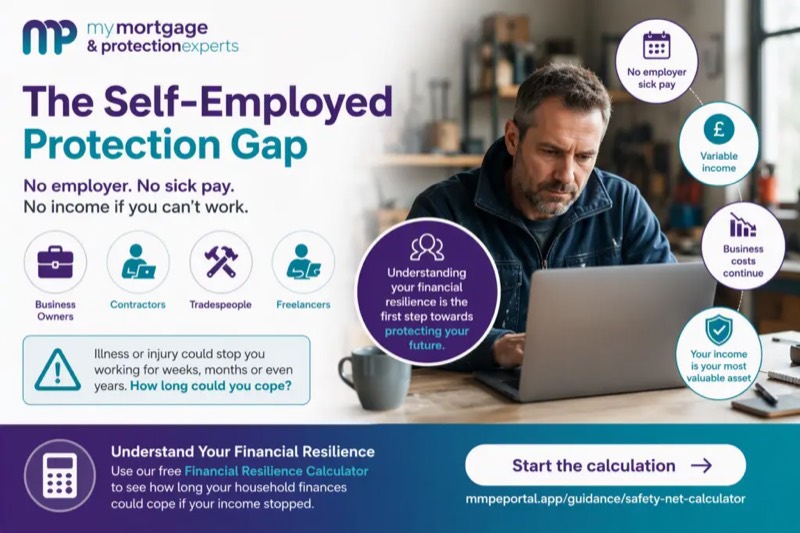
Working for yourself usually means there's no employer sick pay or death in service benefit to fall back on. Once you have a mortgage, it is worth asking how you would keep up payments if illness or injury stopped you working.
Our post on the self-employed protection gap explains the options. You can also use our Financial Resilience Calculator to see how long your household finances could cope if your income stopped.
Our view
Being self-employed isn't a barrier to a mortgage, but it does reward preparation. Tidy figures and the right lender for your income structure make the biggest difference. If you'd like to know where you stand, see self-employed options with us.
Frequently asked questions
How many years of accounts do I need to get a mortgage?
Most lenders want two years of accounts or tax returns, but some will consider one year with a strong case. The right lender depends on how your income is structured, which is where a broker saves you time.
Do lenders look at my salary or my dividends?
If you run a limited company, lenders usually look at your salary plus dividends, though some assess your share of retained profit instead. Which method a lender uses can make a big difference to how much you can borrow.
I've only been trading for a year. Can I still get a mortgage?
Possibly. A smaller number of lenders accept one year of trading, particularly if you have a track record in the same field. It is worth a conversation before you assume the answer is no.
What counts as self-employed for a mortgage?
Lenders generally treat you as self-employed if you own 20% or more of the business you earn from. That covers sole traders, partners and limited company directors.
Does reducing my income for tax affect my mortgage?
It can. Lenders lend against the income you declare, so lowering your declared income to reduce a tax bill may also reduce how much you can borrow.