
My mortgage rate ends in the next 12 months: what to do now
Homeowners with fixed rates ending in the next year, including into 2027, have time to plan, not panic. Here's what to do and when.
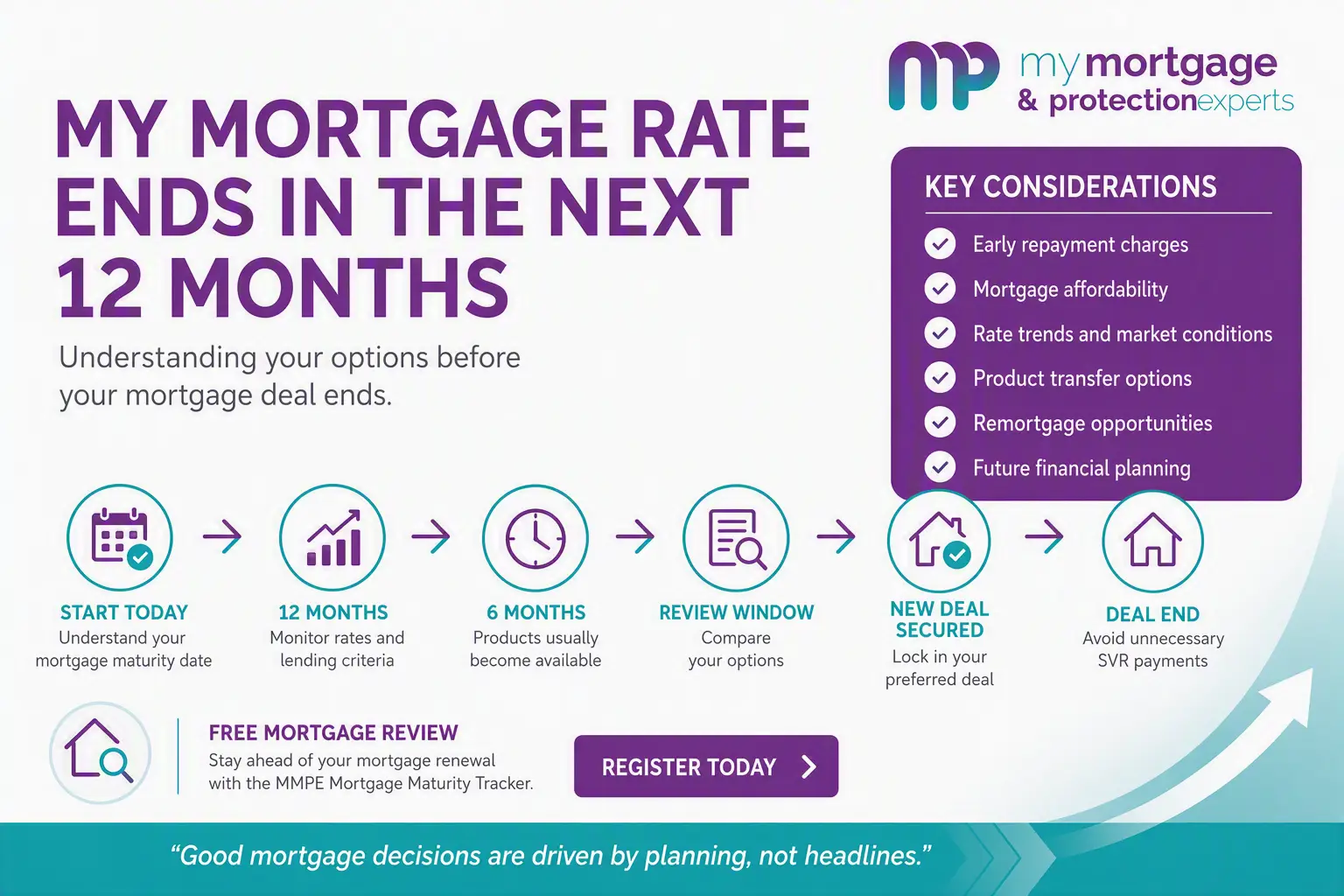
If your mortgage rate ends in the next 12 months, you have time to plan, not panic. This guide is for homeowners whose deal ends within the year, including those with fixed rates ending in 2027. It covers what happens when a deal ends, when to start looking and the choices you have.
Published in September 2026. Rates and figures in this article were correct at the time. For where things stand today, speak to an adviser.
Key takeaways
- When a fixed rate ends, your lender moves you onto their standard variable rate (SVR) unless you've arranged a new deal.
- Most lenders let you secure a new product around six months before your current deal ends.
- Reviewing early gives you time to compare a product transfer with a remortgage to a new lender.
- A higher property value may move you into a lower loan to value band, which can widen your choice of rates.
- Registering your end date means an adviser can get in touch at the right time.
What homeowners need to know about remortgaging and avoiding the standard variable rate
Sam Hubbard and the CeMAP qualified team at My Mortgage & Protection Experts recommend reviewing your options six months before your deal ends. Our free Sussed app can also keep an eye on the market for you in the meantime.
Securing a new rate up to six months before your deal expires avoids the automatic move to the SVR. At the time of writing, the SVR typically ran 2% to 4% higher than a fixed deal. We review options early, comparing product transfers and remortgages across the market, to find suitable terms before your deal ends.
What happens when your fixed deal ends?
A fixed rate deal doesn't simply expire and leave you in limbo. Lenders shift borrowers onto their SVR the moment the fixed term finishes, unless action is taken beforehand. If you miss your lender's letters, the switch can feel like it happens quietly.
The financial impact can be significant. A higher rate on a typical mortgage means a noticeably larger monthly payment. Homeowners who assume no news is good news often only spot the increase when their direct debit changes.
Is moving to the SVR automatic?
Yes, there's no opt-out process for the transfer itself. Lenders move borrowers onto the SVR by default the day the fixed term ends, whether or not a replacement deal has been arranged.
How much more expensive is the SVR than a fixed rate?
When this article was written, the gap typically ran 2% to 4% above a fixed deal. Over a full mortgage term, a difference like that adds up quickly. Reviewing options before your deal ends helps you avoid paying that premium unnecessarily.
We support homeowners through rate switches and product transfers, helping them line up a new deal before the SVR takes hold. The aim is to turn what feels like a confusing deadline into a straightforward decision.
Your mortgage rate ends in the next 12 months: why review now?
Reviewing early protects you from last-minute rate rises and a narrower choice. Most lenders let borrowers secure a new rate up to six months before the current term ends, and waiting until the final weeks removes that buffer.
My Mortgage & Protection Experts is an independent UK brokerage led by an adviser with over 25 years of industry experience. We guide homeowners through this window with whole of market advice tailored to their circumstances. Our paraplanning team specialises in mortgage research and affordability calculations, so you have the groundwork for a timely decision.
What happens if a homeowner reviews too late?
Leaving it late risks drifting onto your lender's SVR, which is often a costlier fallback than a new deal. Rate movements between now and your end date can also change the products on offer. Reviewing early creates room to compare:
- remortgaging with a new lender for a potentially lower rate
- product transfers, staying with your current lender
- holding your position on your existing deal until closer to the end date, where that suits your circumstances
Each route has different trade-offs, so weigh them up well before your deadline.
When should you start looking for a new mortgage deal?
Most lenders allow a new mortgage product to be secured around six months before your current deal ends. That makes it the natural point to start a proper review.
Starting early gives you more choice. Rates and products shift over time, so reviewing well ahead lets you compare a wider range of options rather than whatever is available in the final few weeks.
An early review also gives you time to check affordability properly. Your income, outgoings and lenders' criteria can all change between one deal and the next, so working through the numbers early helps you spot issues while there's still time to fix them. Both routes are worth weighing side by side:
- a product transfer, staying with your current lender on a new rate, usually with a simpler process
- a remortgage, moving to a new lender for whole of market pricing, which may suit you if your circumstances or property value have changed
If your fixed rate ends in 2027, our guide on what to do when your fixed rate is ending in 2027 sets out a simple timeline.
What are your choices if rates stay high?
You still have routes to a manageable mortgage, even if borrowing costs stay high. A rise in your property's value can move you into a lower loan to value band, which may open up lower rates despite the wider market.
When this article was written, some forecasts suggested rates might stay higher rather than fall sharply. One forecast quoted at the time, from the US mortgage agency Fannie Mae, pointed to average US mortgage rates near 6.7% in 2027. That's a US figure and UK rates are set differently, so treat it as a sign of uncertainty rather than a guide to UK pricing.
Can a higher property value lower my rate?
It can. Lenders price mortgages partly on loan to value, so a property that has gone up in value since its last valuation may move you into a lower pricing band. This applies whether you stay with your current lender or remortgage elsewhere.
Reviewing your protection at the same time
Reviewing early matters more than waiting for rates to fall. We pair remortgage advice with a review of your protection, such as life cover, income protection and critical illness cover. Check what you already have, including employer benefits like death in service and sick pay, so your cover fits your new mortgage.
Practical options typically include:
- remortgaging with a new lender to access rates from across the market
- switching products with your current lender
- checking your loan to value after a fresh property valuation
- reviewing protection cover, such as income protection or critical illness cover, alongside the new mortgage
Clients can also keep an eye on their mortgage through the Sussed app, which reminds you before your deal expires.
Stay ahead with the mortgage maturity tracker
Concerned about a mortgage deal ending in the next 12 months or beyond? It may be too early to secure a new rate, but understanding your options now helps you approach your next remortgage or product transfer with confidence. One of the most useful things you can do is plan ahead.
We created our Mortgage Maturity Tracker to help homeowners stay informed and avoid leaving their review until the last minute. When you register your mortgage end date, we can help you review your mortgage both now and in the future. There's no obligation and no cost to register or to attend an initial mortgage review meeting.
What is a mortgage maturity tracker?
It's a simple way to register when your mortgage deal ends, so an adviser can get in touch at the right time rather than leaving the review to chance. It lets us:
- note when your current mortgage deal is due to end
- send you reminders ahead of your renewal
- contact you at a time that suits you
- review whether your existing mortgage still suits your circumstances
- look at remortgage options and product transfers that may lower your monthly payments
- discuss extra borrowing where you need it
- help with changes such as adding or removing someone from the mortgage
- keep you informed about Bank of England base rate changes and other mortgage rate movements
The form takes a couple of minutes. More importantly, it lets us help you build a plan based on your circumstances rather than reacting to headlines at the last minute.
Our view
If your mortgage rate ends within the next 12 months, there's no need to panic, but there's every reason to plan ahead. Property value, balance, future plans, affordability and lenders' criteria all shape the right choice, and good reviews are driven by preparation rather than headlines. Start the conversation early, and compare a product transfer with your other options.
Stay ahead of your mortgage renewal.
Your mortgage deal doesn't need to be ending soon for you to start planning ahead. Register your mortgage end date with My Mortgage & Protection Experts and we can contact you at the right time to review your options.
Whether your deal ends in a few months or further down the line, we'll help you stay one step ahead.
Register your mortgage end date- 1Register your end dateNo obligation and no cost.
- 2We get in touch at the right timeBefore your deal ends, so there's time to plan.
- 3We review your optionsYour lender's offer against the wider market.
Frequently asked questions
What happens when my mortgage fixed rate ends?
Unless a new deal is arranged beforehand, the lender moves the mortgage onto their standard variable rate (SVR) the day the fixed term ends. It happens without any action from you, which is why a higher payment can catch people off guard.
How early can I remortgage?
Most lenders allow a new mortgage product to be secured around six months before the current deal ends. Starting a review at that point gives you a wide choice of remortgage options and product transfers.
Can I secure a mortgage deal six months before expiry?
Usually, yes. Securing a new rate up to six months ahead is standard practice with most lenders, and it helps you avoid the automatic move to the SVR.
What is a mortgage product transfer?
A product transfer means switching to a new rate with the same lender rather than moving elsewhere. It's often simpler than remortgaging, but it's worth comparing with the wider market first.
What is the MMPE Mortgage Maturity Tracker?
It's our free, no-obligation way to register when your mortgage deal ends, so we can get in touch at the right time with a review. You can register your mortgage end date online in a couple of minutes.