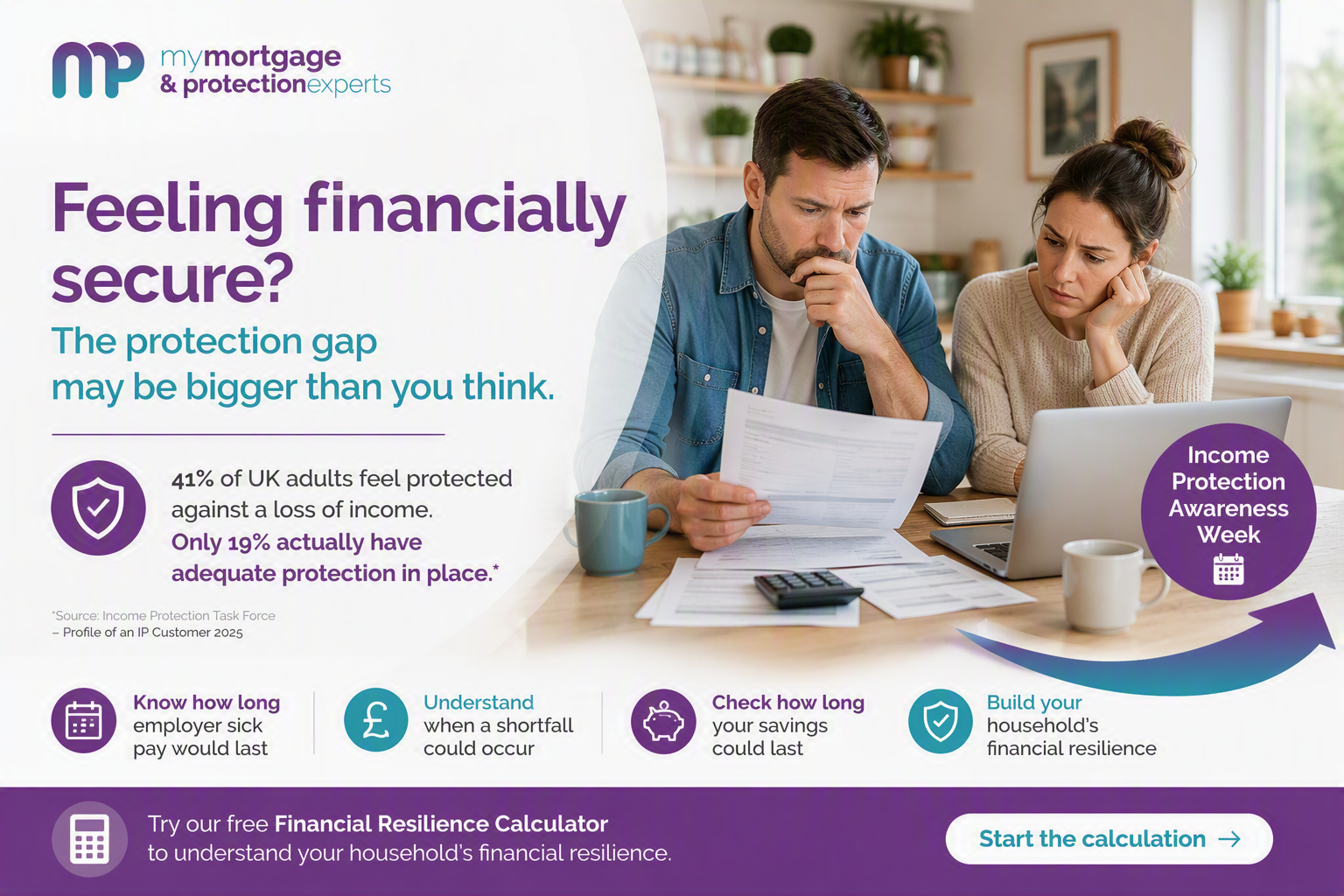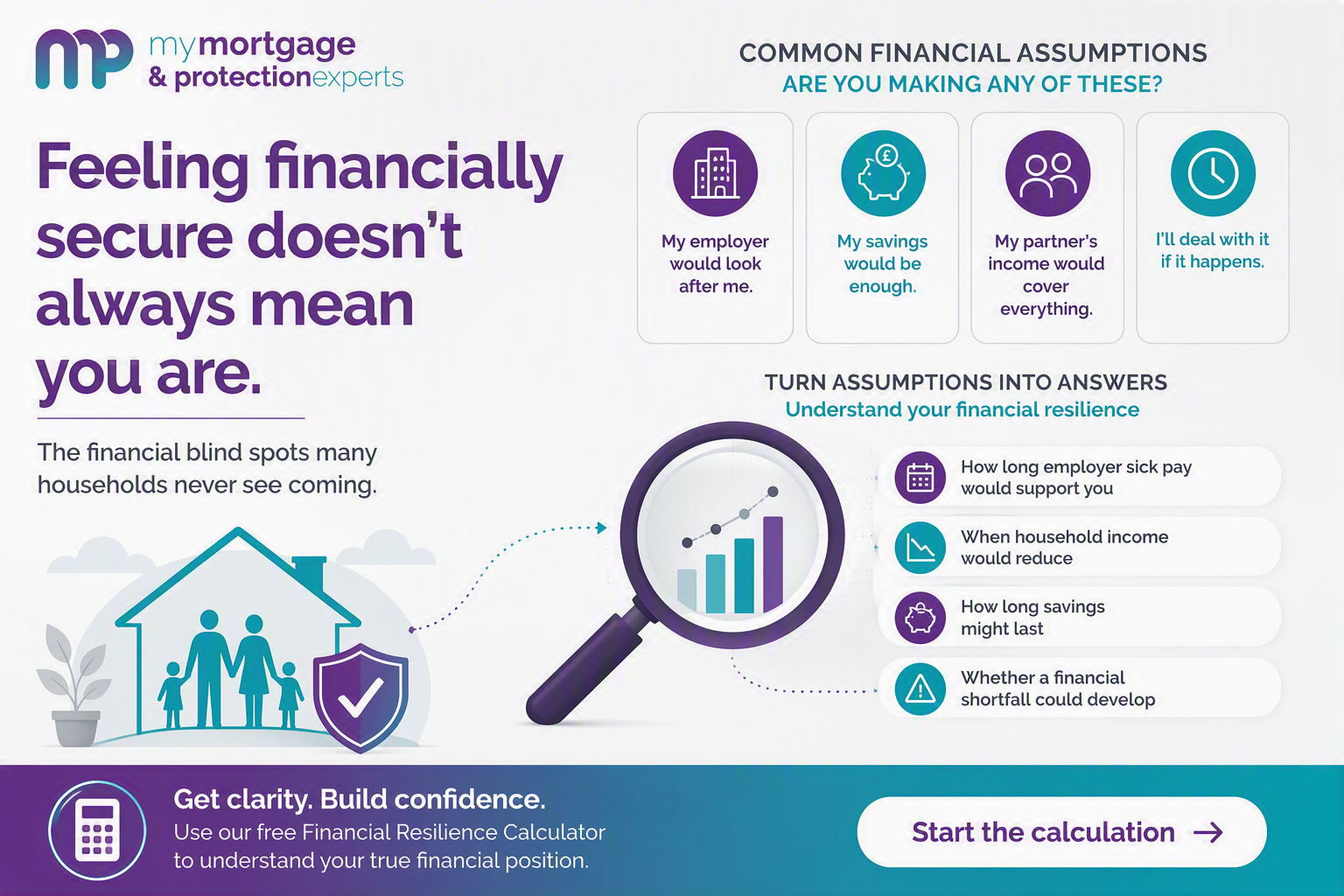
The financial blind spots many households never see coming
Most people like to think they have their finances under control.
They know roughly what they earn, what their mortgage or rent costs, and how much they have in savings. They pay their bills on time, keep an eye on their bank account and generally feel comfortable that they could cope if life threw them a curveball.
But there is a difference between feeling financially secure and actually being financially resilient.
And during Income Protection Awareness Week, that distinction is worth exploring.
The biggest risks to our finances are not always the ones we ignore.
Often, they’re the ones we assume we’ve already dealt with.
The Assumption Trap
Financial resilience isn’t usually undermined by a lack of effort.
More often, it is undermined by assumptions.
Assumptions feel safe because they allow us to avoid difficult questions.
Questions like:
- How long would employer sick pay actually last?
- How much would my household income reduce if I couldn’t work?
- How long could my savings realistically support us?
- Would my partner’s income be enough on its own?
- At what point would we start running short each month?
Many people don’t know the answers.
They simply assume everything would work out.
The problem is that assumptions rarely pay the mortgage.
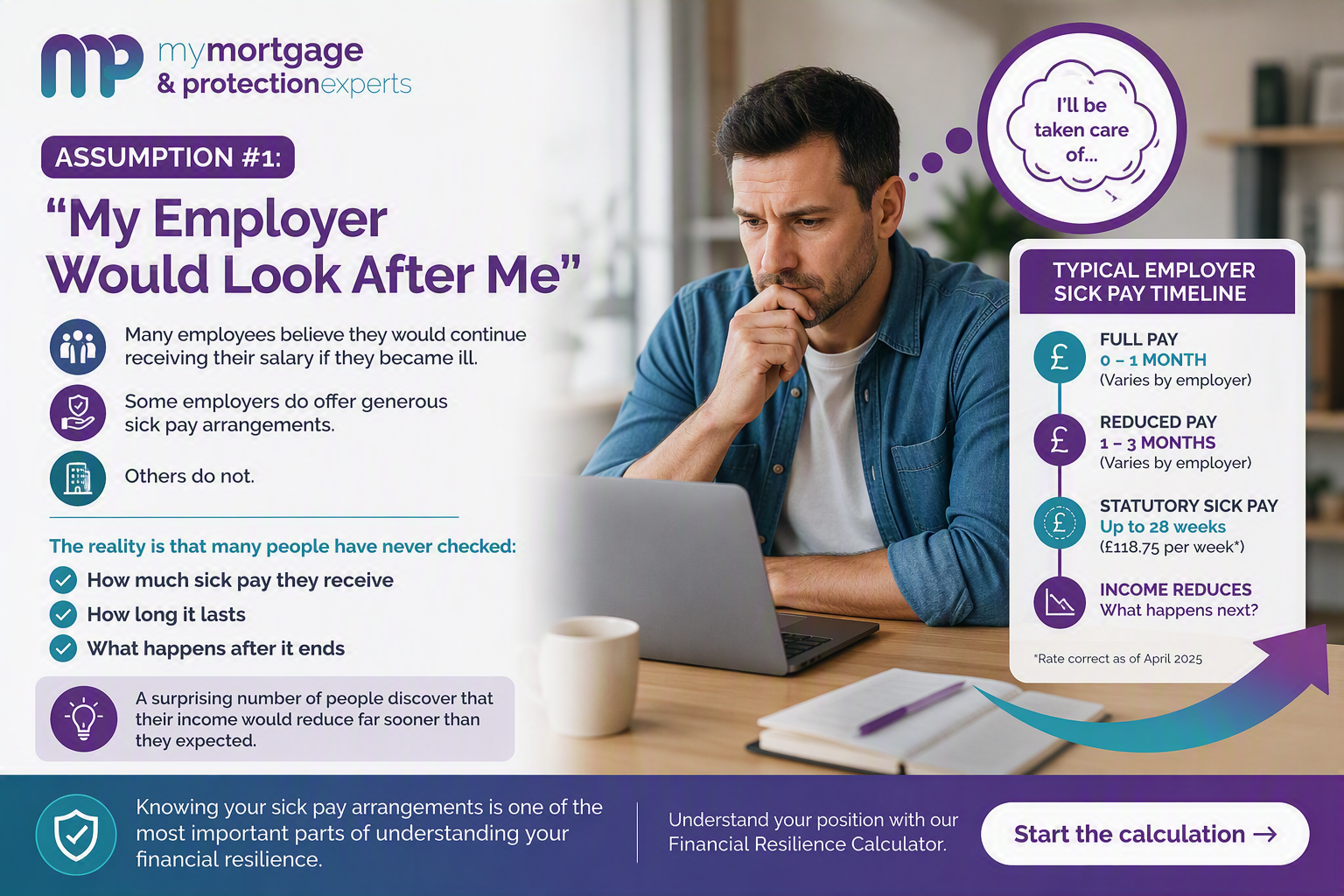
Assumption #1: “My Employer Would Look After Me”
Many employees believe they would continue receiving their salary if they became ill.
Some employers do offer generous sick pay arrangements.
Others do not.
The reality is that many people have never checked:
- How much sick pay they receive
- How long it lasts
- What happens after it ends
A surprising number of people discover that their income would reduce far sooner than they expected.
Knowing your sick pay arrangements is one of the most important parts of understanding your financial resilience.
Assumption #2: “My Savings Would Be Enough”
This is perhaps the most common financial blind spot.
Many households take comfort from having money set aside.
And rightly so.
Savings are a valuable part of any financial safety net.
But resilience is not measured by how much money you have saved.
It is measured by how long those savings would actually last.
A household with £10,000 in savings may feel comfortable.
But if essential expenditure is £3,000 per month, those savings may disappear faster than expected.
The key question isn’t:
“How much have I saved?”
It’s:
“How many months would those savings support my household?”
Most people have never done the calculation.
Assumption #3: “My Partner’s Income Would Cover Everything”
Dual-income households often assume one income could support the family if the other stopped.
Sometimes that’s true.
Sometimes it isn’t.
Today’s households often rely on two incomes to maintain their lifestyle and meet financial commitments.
Mortgage payments, childcare costs, transport expenses and utility bills can quickly reveal how dependent a household is on both earners.
The only way to know for certain is to test the numbers rather than relying on assumptions.
Assumption #4: “I’ll Deal With It If It Happens”
This may be the most dangerous assumption of all.
Most financial decisions are easier to make before a crisis than during one.
When income reduces unexpectedly, households often find themselves making decisions under pressure.
That isn’t usually the best time to work out:
- What support is available
- How long savings might last
- Which bills can be reduced
- Whether there is a financial shortfall
Financial resilience is not about predicting the future.
It’s about understanding your options before you need them.
The Difference Between Confidence and Clarity
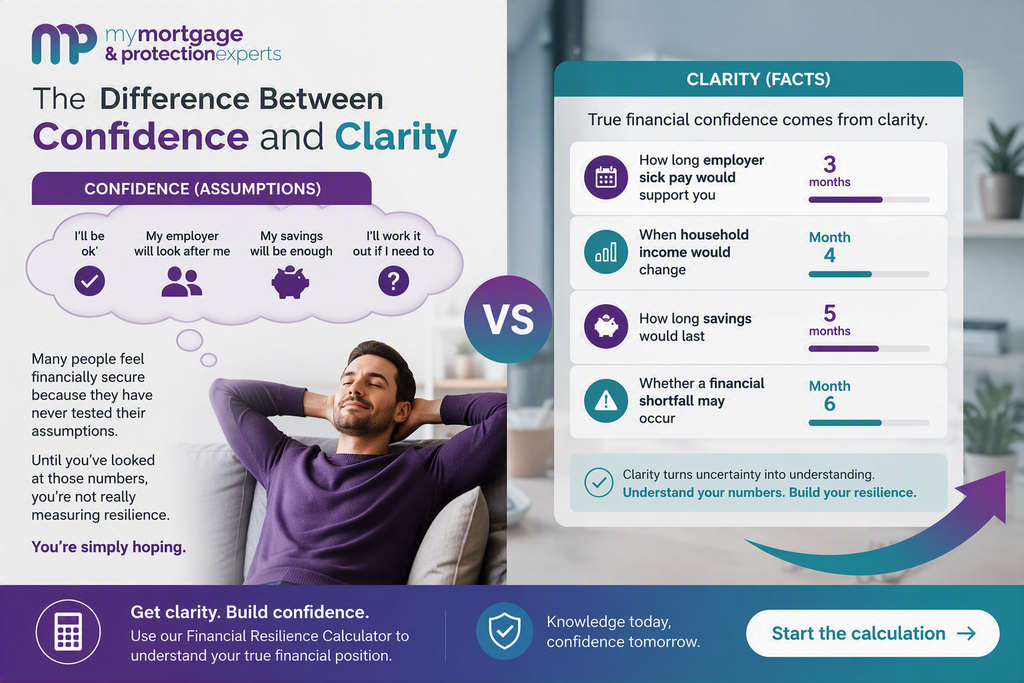
Many people feel financially secure because they have never tested their assumptions.
True financial confidence comes from clarity.
Clarity comes from understanding:
- How long employer sick pay would support you
- When household income would change
- How long savings would last
- Whether a financial shortfall may occur
Until you’ve looked at those numbers, you’re not really measuring resilience.
You’re simply hoping.
Test Your Assumptions
Stop Guessing. Start Measuring.
One of the simplest ways to identify financial blind spots is to stop guessing and start measuring.
That’s why we created the MMPE Financial Resilience Calculator.
The calculator helps households understand:
✅ How long employer sick pay could support them
✅ When household income may reduce
✅ How long savings could last
✅ Whether a financial shortfall could develop
The purpose isn’t to sell a product.
It’s to help people replace assumptions with information and gain a clearer understanding of their household finances.
Try the Financial Resilience Calculator:
Start the calculation
A Better Question This Income Protection Awareness Week
Rather than asking:
“Am I financially secure?”
Ask:
“How do I know?”
Can you confidently explain:
- How long your income would continue?
- What resources you could rely upon?
- How long your household could maintain its current lifestyle?
If not, that’s not a problem.
In fact, recognising the gap is often the first step towards addressing it.
Because the biggest financial risks are rarely the ones we can see.
They’re the assumptions we never stop to challenge.
This article is intended for general information purposes only and does not constitute financial advice. Individual circumstances differ and professional advice should be sought before making decisions regarding protection or financial planning arrangements.