What you need to know to renew or remortgage
For many homeowners, a mortgage is one of the largest monthly commitments. Yet it is surprisingly easy to lose track of when a fixed rate, tracker, or discounted mortgage deal is due to end. The problem is that if you do nothing, your lender will often move you onto their Standard Variable Rate (SVR), which can result in significantly higher monthly payments.
The good news is that there are usually several warning signs that your mortgage deal is coming to an end, giving you time to review your options and potentially secure a new deal.
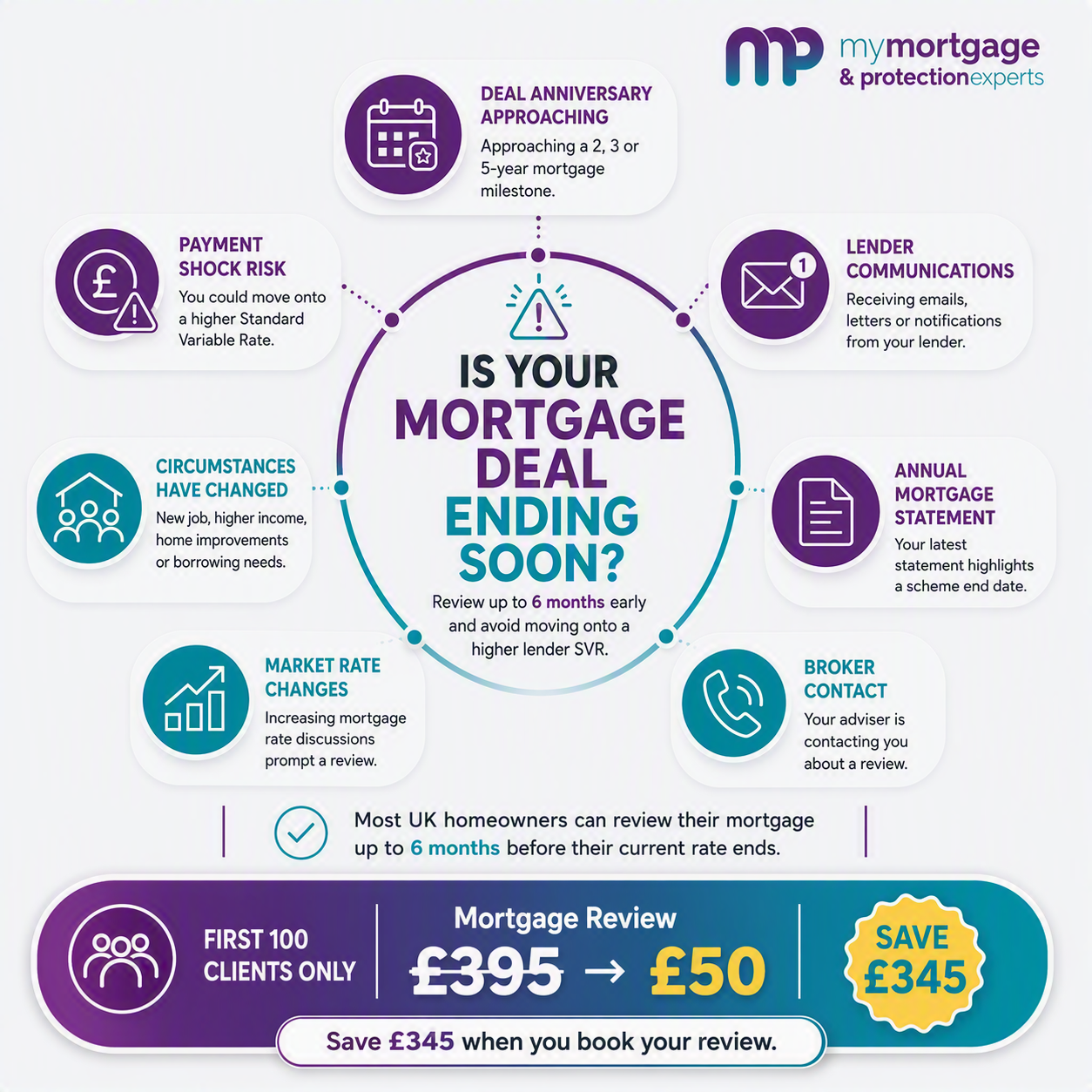
1. Your Fixed Rate Is Within Six Months of Expiring
One of the clearest signs is simply checking your mortgage paperwork.
Most lenders allow you to secure a new mortgage offer up to six months before your current deal ends. This means you do not need to wait until the final few weeks to start looking at your options.
By reviewing your mortgage six months before the expiry date, you can:
- Compare rates across the market
- Review product transfer options with your current lender
- Protect yourself against future rate increases
- Avoid last-minute pressure
Many homeowners who leave things too late find themselves rushed into making decisions.
2. Your Lender Starts Contacting You
Lenders will often begin contacting borrowers several months before their deal expires.
You may receive:
- Letters explaining your current mortgage is nearing its end
- Emails inviting you to review mortgage options
- Notifications within your online banking portal
- Product transfer offers from your existing lender
These communications should never be ignored. They are a strong indication that your lender expects your current arrangement to end soon.
3. Your Annual Mortgage Statement Highlights a Deal End Date
Most mortgage statements include important information such as:
- Mortgage balance
- Interest rate
- Monthly payment
- Product type
- Scheme end date
Many homeowners file these away without reviewing them. However, your annual statement is often one of the easiest places to confirm exactly when your current mortgage deal finishes.
If your mortgage end date is approaching, now is the perfect time to start researching your options.
4. You’re Hearing More About Rising Monthly Payments
If friends, colleagues, or the media are talking about mortgage costs increasing, it can be a useful reminder to check your own arrangements.
Many homeowners become aware of their own looming mortgage review simply because they realise others are nearing the end of their fixed-rate deals.
It’s worth asking yourself:
- When does my current rate end?
- What rate would I move onto afterwards?
- Could my mortgage payment increase?
The earlier you ask these questions, the more options you are likely to have.
5. You’re Approaching a Key Mortgage Anniversary
Many mortgage products run for:
- Two years
- Three years
- Five years
- Ten years
If you know roughly when you purchased your home or last remortgaged, you can often estimate when your current deal may be ending.
For example: Bought your home in September 2021 on a five-year fix? Your deal could be ending around September 2026. If you are approaching one of these milestones, it is worth checking your documentation now.
6. Your Broker Contacts You
A proactive mortgage broker will often start discussions months before your current deal expires.
This is usually a sign that:
- Your mortgage review period has started
- Better rates may be available
- Your existing lender’s options should be reviewed
- A wider market comparison could be worthwhile
If your adviser gets in touch, it is generally because action can now be taken to help protect your future payments.
7. Your Circumstances Have Changed
Even if your mortgage deal is still months away from expiring, changes in your circumstances can make a review worthwhile.
Examples include:
- Salary increases
- A new job
- Self-employment
- Home improvements
- Additional borrowing needs
- Debt consolidation requirements
- Plans to move home
Click here to claim your £345 remortgage discount today →
What Happens If You Do Nothing?
Many homeowners are surprised to discover that once their introductory deal finishes, they may automatically move onto their lender’s Standard Variable Rate.
This can result in:
- Higher monthly payments
- Reduced budgeting certainty
- Missed opportunities to secure competitive rates
Cost Warning: Even a short period on a higher variable rate can cost hundreds of pounds more than necessary.
Worked Numerical Case Study
Consider a 350,000 mortgage transitioning from a 2.2% fixed rate to an 8.25% SVR without action:
- Current 2.2% fixed rate monthly payment: approximately 31,350
- Monthly payment on SVR at 8.25%: approximately 3,579
- Increase of 229 per month if moved onto SVR by default
Alternatively, securing a new fixed rate deal at 4.3% can reduce costs significantly:
- New 4.3% fixed rate monthly payment: approximately 3,305
- Monthly saving compared to SVR: 274
- Saving compared to default SVR monthly payments: 274
Taking prompt action can save hundreds each month and ensure budgeting certainty.
How Early Should You Review Your Mortgage?
We typically recommend reviewing your mortgage between six and twelve months before your current deal ends.
Starting early provides:
- ✅ More choice: Access whole-of-market options before deadlines loom.
- ✅ More time to prepare documentation: Ensure your paperwork and proof of income are in order.
- ✅ The opportunity to secure a rate in advance: Lock in today’s best product up to 6 months early.
- ✅ Protection from unexpected delays: Keep legal and valuation processing on schedule.
- ✅ Less stress as your deal expiry approaches: Smooth transition to your new product without SVR exposure.
6-12 Month Mortgage Review Checklist
- Check your mortgage end date and fixed-term expiry.
- Gather all relevant financial documentation (income proof, expenses, ID).
- Assess any recent changes in your financial situation or credit rating.
- Consult your mortgage broker or adviser for market options.
- Compare whole-of-market deals including fees and terms.
- Apply early to lock in competitive rates and avoid last-minute rush.
- Prepare for any legal or valuation surveys.
Final Thoughts
If your mortgage deal is ending within the next six months, now is the ideal time to start planning. Waiting until the last minute could reduce your options and potentially increase your monthly payments.
By staying proactive, reviewing your mortgage early, and seeking professional guidance where required, you can ensure you’re in the strongest possible position when your current deal comes to an end.
Click here to claim your £345 remortgage discount today →
About MMPE Advisers
All advisers at My Mortgage & Protection Experts are CeMAP qualified mortgage specialists with experience across mortgages, remortgaging and protection planning. Our team is committed to providing clear, professional advice tailored to each client’s circumstances, helping homeowners make informed decisions about their mortgage options.
⭐ Read our 5-star client reviews below and discover why homeowners trust MMPE for their mortgage and protection advice.
Your home may be repossessed if you do not keep up repayments on your mortgage. You may have to pay an early repayment charge to your existing lender if you remortgage early.