For anyone thinking about buying a home, remortgaging or investing in property, the last few years have brought considerable change.
Higher mortgage rates, inflation and the rising cost of living have all affected affordability. More recently, uncertainty around the direction of Bank of England interest rates has added another question for borrowers: should you act now or wait to see what happens to mortgage rates?
The latest Nationwide Autumn Economic Update provides some useful insight.
While the immediate economic outlook remains uncertain, there are also encouraging signs beneath the headlines. The UK housing market remains relatively resilient, mortgage availability has improved in some important areas and the longer-term outlook for interest rates may not be quite as negative as current market expectations suggest.
Here are some of the key points for homeowners, homebuyers, first-time buyers and landlords.
What could happen to UK interest rates?
Interest rates remain one of the biggest factors affecting the UK mortgage market.
Financial markets are currently pricing in the possibility of four Bank of England rate increases over the next 12 months. However, Robert Gardner’s assessment in the Nationwide update was that one or two increases may be more likely than four.
This distinction matters.
Mortgage lenders don’t simply wait for the Bank of England to change Bank Rate before changing their mortgage pricing. Swap rates, which influence the pricing of many fixed-rate mortgages, have already increased substantially.
In other words, some of the expected future tightening in monetary policy may already be reflected in current mortgage rates.
Does this mean mortgage rates will fall?
Not necessarily.
Inflation remains a concern, particularly following renewed pressure on global energy prices. Near-term CPI inflation is expected to move towards 4%, making further action from the Bank of England possible.
There are, however, signs that some underlying inflationary pressures are easing.
Unemployment has increased from its 2022 low, there are now more unemployed people for every available vacancy, and private-sector wage growth has moderated.
The result is an unusually uncertain outlook.
Rather than trying to predict exactly where UK mortgage interest rates will go next, borrowers may benefit from focusing on the things they can control.
Should I wait for mortgage rates to fall?
This is likely to be one of the biggest questions for borrowers.
Unfortunately, nobody can reliably predict exactly where mortgage rates will be in six or twelve months.
Waiting for rates to fall has a potential benefit if borrowing costs subsequently reduce, but it also carries the risk that rates remain higher for longer or increase further.
For someone approaching the end of a fixed-rate mortgage, it can therefore be sensible to review remortgage options well before the existing deal expires, rather than waiting until the last minute.
Depending on the lender and mortgage product, there may also be opportunities to secure an available deal and review the position again before completion if the market changes.
The right approach depends on your circumstances, your existing mortgage and how important payment certainty is to you.
The UK housing market is quieter, but it isn’t broken
Mortgage approvals for people purchasing homes are currently running approximately 15% to 20% below pre-pandemic averages, while buyer enquiries also remain subdued.
But there is an important distinction between a quieter property market and a housing market experiencing significant financial distress.
Annual UK house price growth has fallen below 1%, but prices nationally have remained relatively stable, with considerable regional variation.
At the same time, household balance sheets, mortgage availability and previous affordability stress testing provide some resilience.
For buyers, this potentially creates a very different environment from a rapidly rising property market.
There may be less urgency and more opportunity to carefully consider affordability, negotiate and understand the mortgage options available.
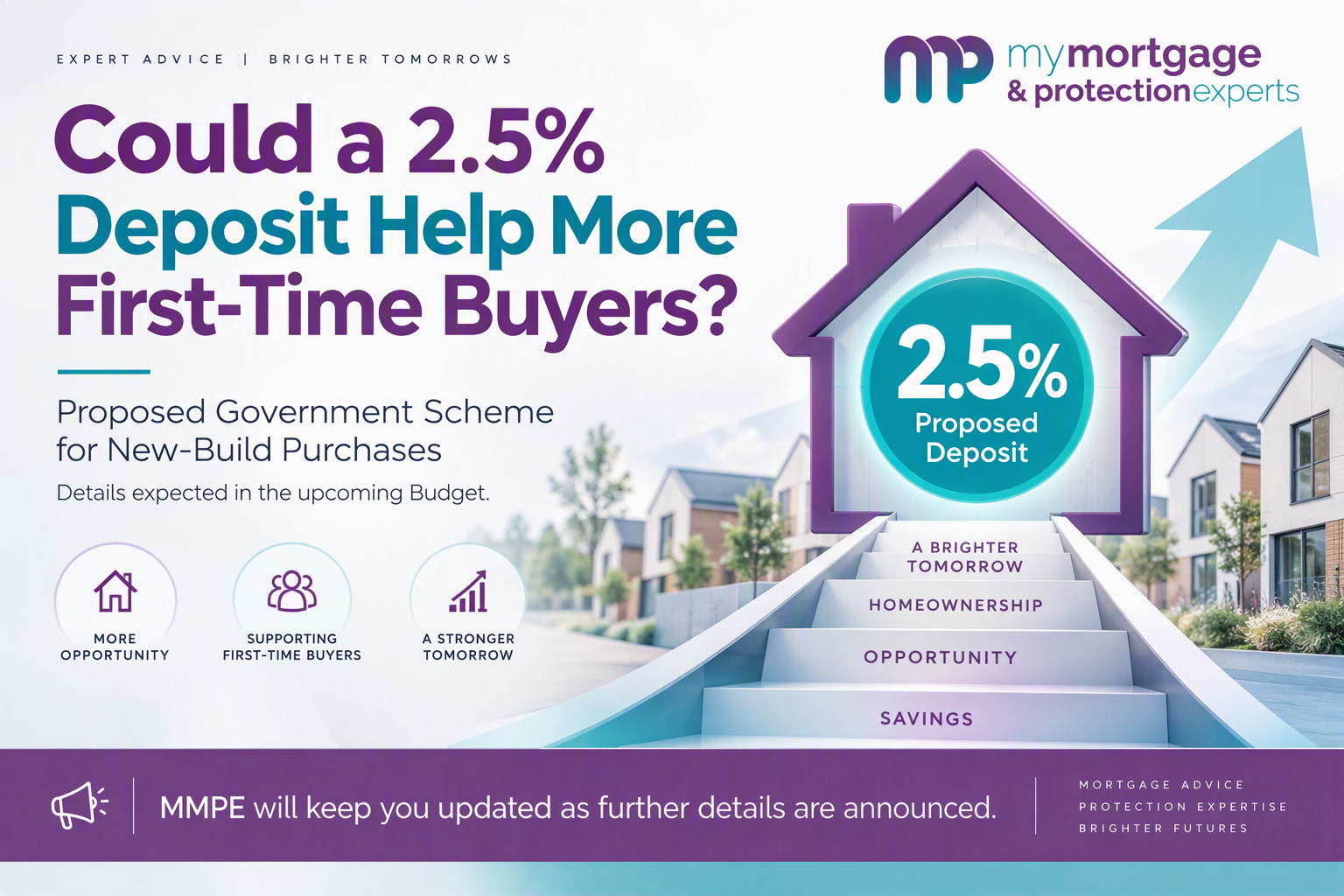
Could this be a better time for first-time buyers?
One of the most encouraging areas of the economic update concerns first-time buyers.
Despite recent increases in swap rates, first-time buyer affordability remains significantly better than it was two years ago.
The typical deposit requirement for somebody buying with a 10% deposit, relative to their income, is also below its 20-year average.
Just as importantly, availability of high loan-to-value mortgages is now at its highest level since the 2008 financial crisis, while access to higher loan-to-income lending has also expanded.
That doesn’t mean buying your first home has suddenly become easy. Saving a deposit and demonstrating affordability remain significant challenges for many households.
But it does mean that if you investigated buying a home a year or two ago and decided it wasn’t affordable, it could be worth reviewing your position again.
The mortgage market has changed.
First-time buyer affordability varies dramatically across the UK
National statistics don’t always tell the full story.
The Nationwide update highlights significant differences in the profile of first-time buyers across different regions.
In London, average first-time buyer incomes are around 50% higher than average regional earnings. In areas including Scotland, Yorkshire and the Humber, and the North, actual first-time buyer incomes are much closer to, or below, regional averages.
This reinforces the importance of looking at affordability at an individual and regional level rather than relying on national headlines.
Your income, deposit, existing commitments and the property you’re hoping to purchase ultimately matter much more than the average UK figure.
Why are more borrowers choosing two-year fixed and variable mortgages?
An interesting change is taking place in the types of mortgages borrowers are selecting.
Variable-rate mortgages have increased from around 4% to approximately 20% of applications over the past six months.
At the same time, two-year fixed-rate mortgages have been gaining popularity relative to five-year fixed deals, even though shorter-term fixes may currently carry higher rates.
Why?
One possible explanation is that borrowers are reluctant to commit to today’s mortgage rates for five years if they believe rates could eventually become lower.
But there is an important trade-off.
A shorter mortgage deal
A shorter fixed period can allow you to review your mortgage sooner if rates subsequently fall.
However, you may also have to refinance sooner if rates remain high or increase.
A longer fixed-rate mortgage
A longer fixed rate can provide greater certainty over monthly repayments.
However, you could remain tied into that rate if cheaper mortgage deals become available, potentially subject to early repayment charges if you want to leave early.
Neither approach is automatically right or wrong.
The better question is:
How important is certainty to you compared with flexibility?
That’s where personalised mortgage advice can become particularly valuable.
What does the outlook mean if you’re remortgaging?
Approximately 90% of outstanding UK mortgages are on fixed rates, which means most borrowers aren’t immediately affected when Bank Rate changes.
The impact often arrives later, when an existing fixed-rate mortgage ends.
Some homeowners are therefore moving from historically low mortgage rates onto considerably higher rates when they remortgage.
Previous mortgage affordability testing and wage growth have helped limit serious financial stress, but that doesn’t mean households won’t notice the difference in their monthly budgets.
A remortgage review therefore shouldn’t necessarily focus solely on finding the lowest headline interest rate.
It can also be an opportunity to consider:
- your remaining mortgage term;
- expected monthly repayments;
- fixed versus variable rates;
- two-year versus five-year fixed mortgages;
- your lender’s product-transfer options;
- overpayments;
- changing income or expenditure;
- future plans for the property;
- household financial resilience; and
- whether your existing life insurance and income protection remain appropriate.
Taking a wider view can sometimes be more valuable than simply comparing headline rates.
What is happening to UK house prices?
UK house prices have remained relatively subdued, with annual national house price growth dipping below 1%.
There are, however, considerable regional differences. Northern Ireland, for example, has experienced much stronger growth, approaching double-digit annual levels in the economic update.
For buyers hoping for a substantial nationwide fall in house prices, the picture is therefore far from straightforward.
Improvements in housing affordability could potentially come from a combination of wage growth, increased mortgage availability and future changes in borrowing costs, rather than a major fall in property values.
That’s another reason why making a decision purely on predictions about future house prices or interest rates can be difficult.
What is happening in the buy-to-let mortgage market?
The UK buy-to-let mortgage market is also changing.
The number of outstanding buy-to-let mortgages has declined since late 2022 as landlords have faced higher borrowing costs alongside tax and regulatory pressures.
Interestingly, however, total buy-to-let lending balances have remained relatively stable because average mortgage sizes have increased.
There are also signs of properties moving away from smaller mortgaged landlords towards outright owners and limited-company ownership.
This suggests that rather than simply disappearing, parts of the private rented sector may be changing in structure.
For landlords, particularly those with several properties or borrowing through a limited company or SPV, this makes it increasingly important to consider financing decisions in the context of rental income, borrowing costs and overall portfolio strategy.
Tax treatment should also be discussed with an appropriately qualified tax adviser.
What does all this mean for the UK mortgage market?
The overriding message is one of cautious optimism rather than certainty.
Economic growth is expected to remain relatively weak in the near term and inflation presents a genuine risk to the interest-rate outlook.
However, there are also positive signals:
- first-time buyer affordability has improved compared with two years ago;
- high-LTV mortgage availability has increased;
- house prices have remained relatively resilient;
- severe mortgage distress remains limited;
- buyers have a wider range of borrowing strategies to consider; and
- interest rates may not ultimately need to rise by as much as financial markets currently anticipate.
The housing market is therefore perhaps better described as subdued rather than broken.
Buying a home or remortgaging? The value of reviewing your options
If there is one message for borrowers to take from the current economic environment, it is this:
Don’t try to time the mortgage market perfectly.
Interest rates, inflation, swap rates and house prices can all change quickly. The mortgage that is suitable for one household may also be completely unsuitable for another.
Instead, understand:
what you can afford, what options are available today, how much certainty you need and how your finances would cope if circumstances changed.
If you’re a first-time buyer, moving home, approaching the end of your fixed mortgage deal or reviewing a buy-to-let mortgage, it may be worth revisiting your options even if you’ve looked previously.
The mortgage market has changed considerably, and your options may have changed with it.
Speak to My Mortgage & Protection Experts
At My Mortgage & Protection Experts, we can review your circumstances, discuss the mortgage options available and help you understand the choices available to you.
Whether you’re buying your first home, moving house, remortgaging or reviewing a buy-to-let property, the aim isn’t to predict exactly what interest rates will do next.
It’s to help you make an informed decision based on your circumstances, your priorities and your plans for the future.
Looking to track your existing mortgage. Mortgage rates and lending criteria can change quickly. Whether your current deal ends in the next few months or further down the line, planning ahead can help you understand your options and avoid moving onto your lender’s Standard Variable Rate (SVR), which could increase your monthly payments.
Your home may be repossessed if you do not keep up repayments on your mortgage.