When people hear the words Income Protection Insurance, they often assume it is expensive, complicated, or only suitable for high earners. In reality, income protection is one of the most flexible protection products available in the UK market and can often be tailored to fit a wide range of budgets.
The real question is not whether you can afford income protection.
The question is whether you could afford to be without an income for months or even years if illness or injury prevented you from working.
The Hidden Risk Most People Overlook
For many households, the ability to earn an income is their most valuable financial asset.
Your mortgage, rent, household bills, food, childcare costs, pension contributions, and lifestyle all depend on money continuing to arrive each month.
Yet millions of UK workers face long-term health issues that prevent them from working.
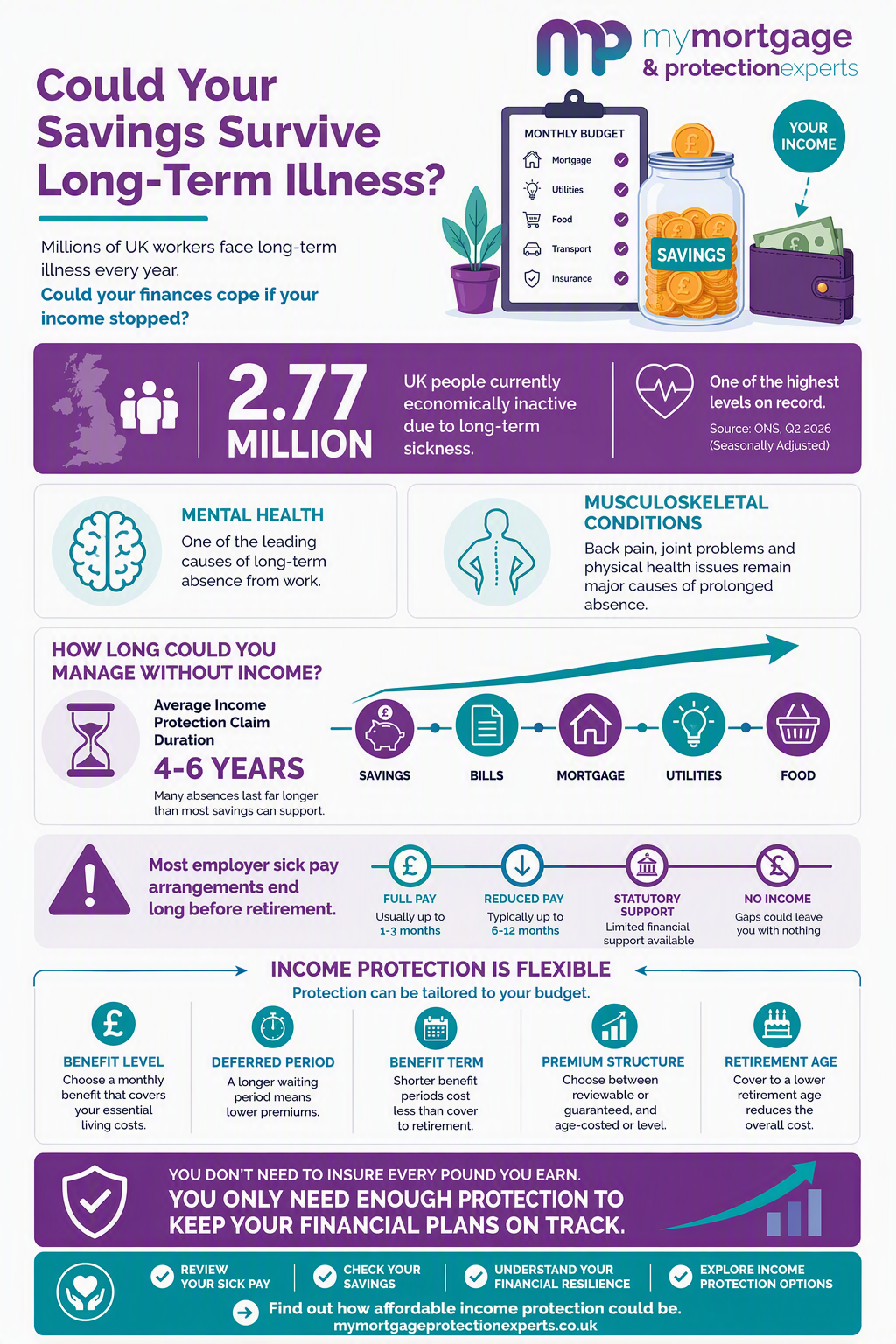
Recent labour market data shows approximately 2.77 million people in the UK are economically inactive due to long-term sickness, representing one of the highest levels ever recorded. [stately-uk…vercel.app], [statista.com]
Many people assume that serious accidents are the main threat to their earnings, but income protection claims are more commonly caused by:
- Mental health conditions
- Musculoskeletal disorders (such as back and joint problems)
- Cancer
- Heart and circulatory conditions
- Neurological illnesses
These are conditions that can affect almost anyone during their working life. [lifecoverfor.com]
Why Savings Are Not Always the Answer
A common response is:
“I’ll use my savings if anything happens.”
Savings are incredibly important and should form part of any financial resilience plan.
However, a prolonged absence from work can quickly erode even substantial savings.
The challenge is that many illnesses last far longer than people expect.
Industry data suggests the average income protection claim lasts between four and six years, with some claims continuing until retirement. [lifecoverfor.com]
Even £20,000 or £30,000 of savings can disappear surprisingly quickly when replacing a full salary and maintaining household commitments.
Income Protection Is More Flexible Than Most People Realise
One of the biggest misconceptions is that there is only one type of income protection policy.
In reality, advisers can adjust several key features to help achieve the right balance between protection and affordability.
Think of income protection as a series of controls that can be adjusted to suit your budget.
1. Benefit Level
The monthly benefit is the amount the insurer would pay if you were unable to work.
A higher benefit means:
- Greater financial protection
- Higher premiums
A lower benefit means:
- Lower premiums
- Less cover
For example, rather than protecting every pound of income, some clients choose to cover only their essential expenditure:
- Mortgage or rent
- Council tax
- Utilities
- Food
- Insurance premiums
Protecting the essentials can often make cover significantly more affordable while still providing meaningful financial security.
Industry analysis suggests many policies are already being arranged on this basis, with benefit levels frequently selected to protect core expenditure rather than full income replacement. [Profile_Of…dition_Web | PDF]
2. Deferred Period (Waiting Period)
The deferred period is how long you wait before the policy starts paying.
Common options include:
- 4 weeks
- 8 weeks
- 13 weeks
- 26 weeks
- 52 weeks
Generally:
Longer waiting period = Lower premium
For example:
Someone with six months of employer sick pay may choose a 26-week deferred period because they already have income protection from their employer during that time.
Aligning the policy with existing sick pay arrangements can dramatically reduce costs.
3. Benefit Term
This is how long the insurer will continue paying once a claim starts.
Options typically include:
Short-Term Cover
- 1 year
- 2 years
- 5 years
Full-Term Cover
- Until retirement age
- Until age 65, 67, or 70
Generally:
Shorter benefit period = Lower premium
A two-year benefit period can be much cheaper than a policy paying until retirement.
While full-term cover provides the most comprehensive protection, shorter-term options can still provide valuable support at a lower cost.
4. Policy End Age
Most policies allow clients to choose when cover ends.
Examples:
- Age 60
- Age 65
- Age 67
- Age 70
The longer the insurer is potentially at risk, the more premiums tend to cost.
Choosing a suitable end age based on retirement plans can help improve affordability.
5. Guaranteed or Reviewable Premiums
Guaranteed Premiums
- Premiums are fixed at outset.
- Do not increase because of changes in claims experience.
- Greater long-term certainty.
Reviewable Premiums
- Usually start cheaper.
- Can be reviewed by the insurer in future.
- May increase later.
Generally:
Reviewable premiums are initially cheaper.
Many clients prefer guaranteed premiums for certainty, but reviewable premiums can be an option when affordability is the primary concern.
6. Age-Costed or Level Premium Structures
Some insurers offer different pricing approaches.
Age-Costed Premiums
- Start lower.
- Increase as you get older.
Non-Age-Costed (Level Style)
- Typically start higher.
- Remain more stable over time.
For younger clients, age-costed premiums can sometimes make it easier to obtain meaningful protection at a lower initial cost.
7. Inflation Protection
Many policies allow the benefit to increase over time.
This helps protect purchasing power against inflation.
However:
- Increasing benefits cost more.
- Level benefits usually cost less.
For clients on a tighter budget, selecting level cover rather than escalating benefits may reduce premiums.
The Difference Small Changes Can Make
Many people are surprised by how much premiums can change when small adjustments are made.
For example, an adviser could reduce cost by:
- Increasing the deferred period
- Reducing the benefit amount
- Selecting a shorter benefit term
- Choosing reviewable premiums
- Choosing age-costed premiums
- Adjusting the retirement age
- Removing inflation linking
This means that a policy initially perceived as too expensive can often be reshaped into something far more affordable without removing protection altogether.
Some Protection Is Usually Better Than None
The perfect policy is not always the most expensive policy.
The best policy is one that:
- Meets your needs
- Fits your budget
- Can be maintained long term
Even a modest level of income protection can prevent a household moving from a temporary health problem into a financial crisis.
A Financial Resilience First Approach
Before arranging any income protection policy, it can be helpful to ask:
- How long would my employer continue paying me?
- How much do I have in savings?
- How long would those savings last?
- What are my essential monthly commitments?
- What income would my household need to remain financially stable?
Once those questions are answered, it becomes much easier to design a policy that balances affordability with protection.
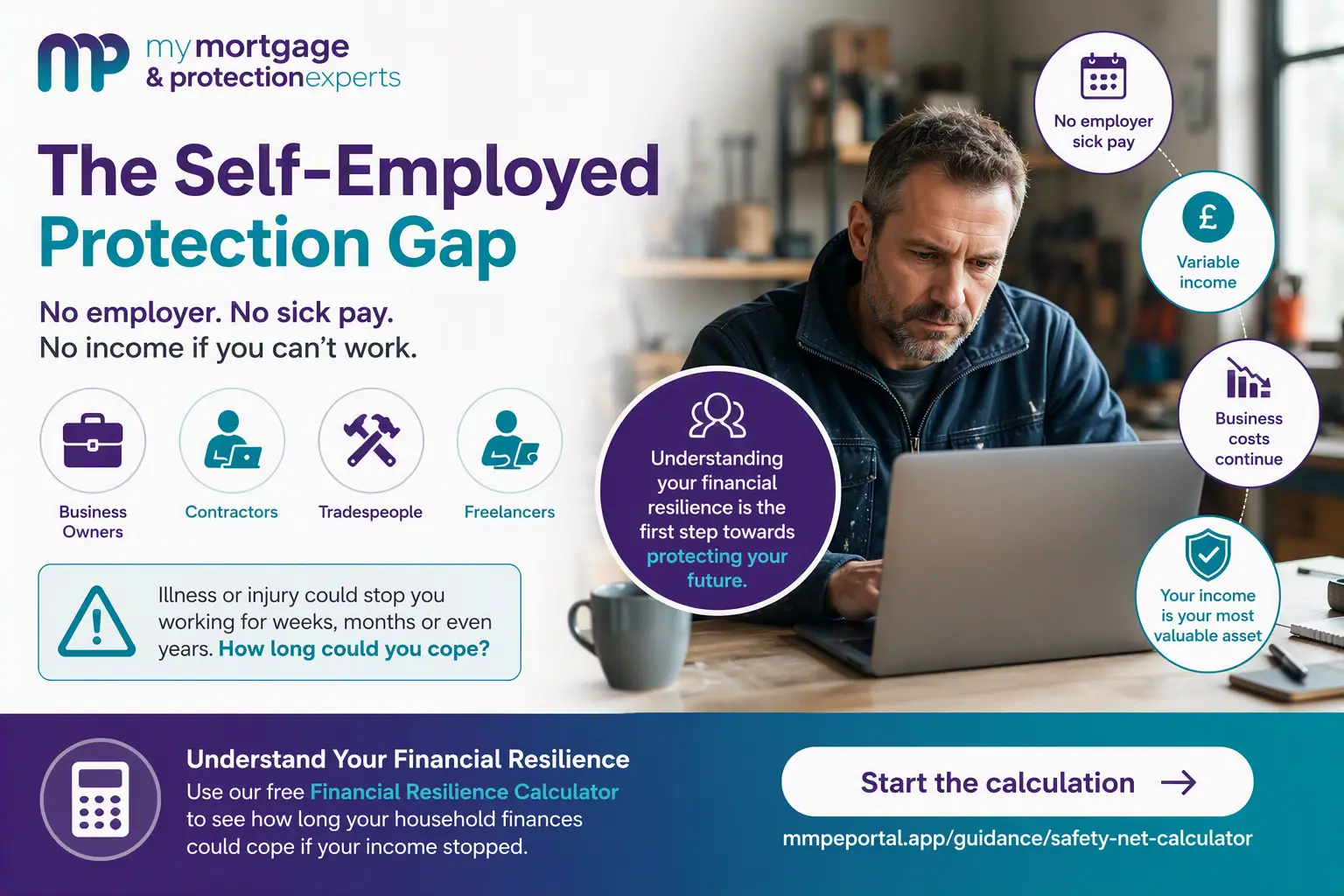
Test Your Assumptions With Our Financial Resilience Calculator
Even if you already have Income Protection, there can be real value in understanding how your household finances would work if you became unable to work.
That’s why we created our Financial Resilience Calculator.
The calculator helps you understand:
How long employer sick pay would support you
When household income may reduce
How long savings could last
How financially resilient your household really is
Importantly, the calculator isn’t designed to sell a product.
It’s designed to help you test your assumptions using real numbers and gain a clearer understanding of your current position.
Because financial confidence is built on clarity, not guesswork.
Try the Financial Resilience Calculator today:
Final Thoughts
Income protection is often described as the protection policy people need most but buy least.
With around 2.77 million people in the UK currently out of the workforce because of long-term sickness, the risk is far from theoretical. [stately-uk…vercel.app], [statista.com]
The good news is that income protection is highly flexible.
Whether your priority is comprehensive cover to retirement or a more budget-conscious solution that simply protects your essential bills, there are usually several ways to tailor a policy to suit your circumstances.
The aim is not necessarily to insure every pound you earn.
The aim is to ensure that if illness or injury stops your income, your financial plans do not stop with it.